

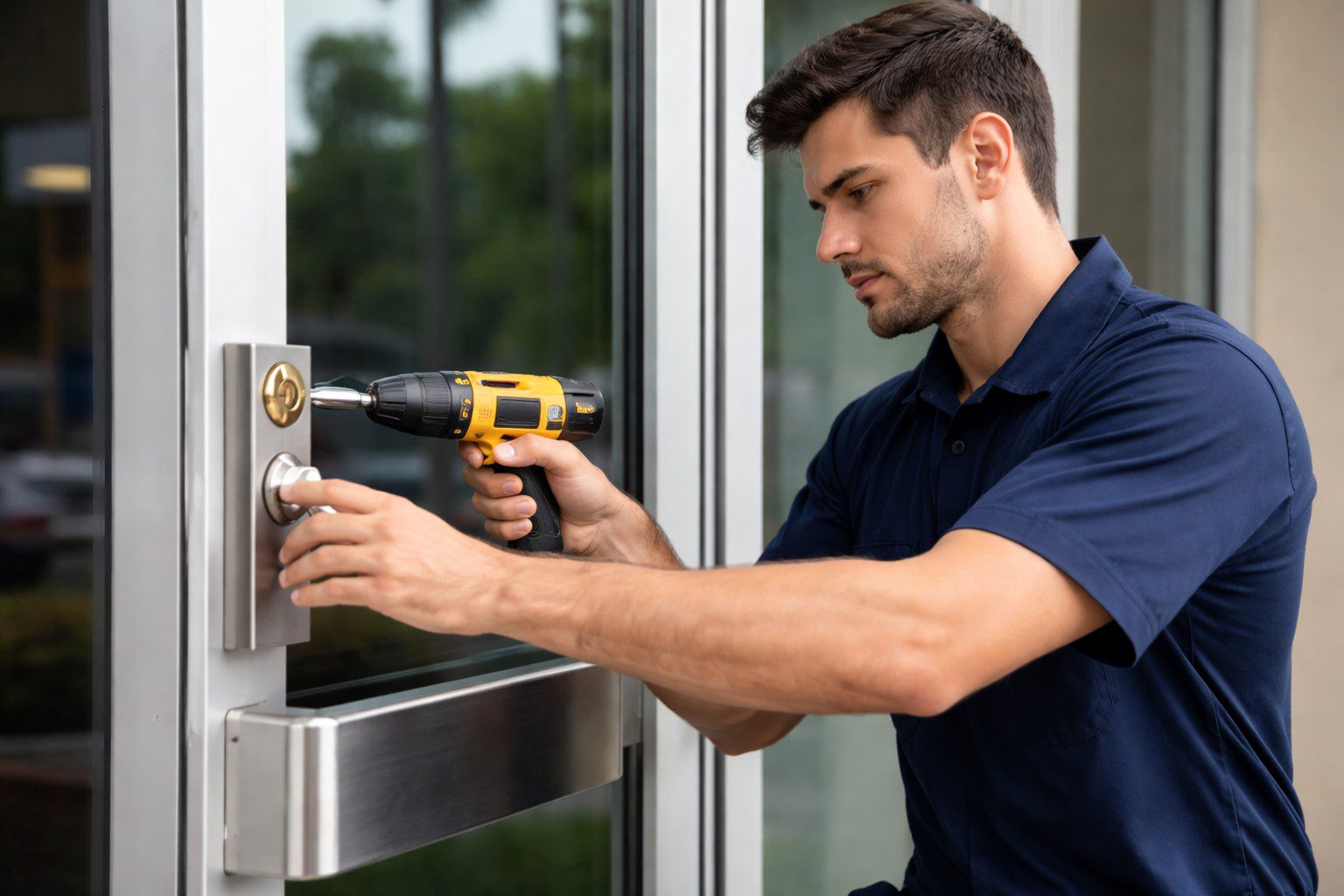
Push bar exit doors (also called panic bars or crash bars) serve an important purpose in commercial buildings. They let people exit quickly during emergencies without fumbling for keys or handles. Fire codes require them in many situations, and they work exactly as intended when someone needs to leave fast.
The problem? That same convenience creates a security vulnerability that many Denver business owners don’t realize exists until it’s too late.
This guide explains the latch failure issue that affects push bar doors, why adding a commercial deadbolt solves the problem without violating safety codes, and what Denver businesses should know before scheduling installation.
The Push Bar Latch Problem Most Business Owners Don’t Know About
Standard push bar mechanisms use a latch that retracts when you press the bar from inside. That latch extends into the door frame’s strike plate to keep the door closed when no one’s pushing from inside.
Here’s where the design falls short: if someone pulls hard enough from the outside, particularly on doors that have settled over time or frames that have shifted slightly, the latch can fail. The metal tongue either bends, the strike plate pulls away from the frame, or the latch simply slides past the strike opening with enough force applied at the right angle.
This isn’t a manufacturing defect. It’s a limitation of how single-point latching systems work. The latch mechanism is designed to retract easily when someone pushes the bar from inside, which means it doesn’t provide the same resistance to force from outside that a deadbolt does.
We’ve responded to multiple Denver businesses over the past year where break-ins occurred through push bar doors. In most cases, there was no visible damage to the door or frame because the intruder simply pulled hard enough to bypass the latch. The business owner reviews security footage, sees someone yank the door open in seconds, and realizes their “secure” exit door was anything but.
How a Commercial Deadbolt Reinforces Push Bar Door Security
A deadbolt adds a second locking point that doesn’t rely on spring tension or a retractable latch. When engaged, a deadbolt extends a solid metal bolt at least one inch into the door frame. Unlike a latch that can be forced back with enough pressure, a properly installed deadbolt can’t be defeated by pulling.
Installing a commercial deadbolt on a push bar door means:
Two independent locking mechanisms. Even if someone bypasses or forces the latch, the deadbolt keeps the door secured.
Resistance to forced entry. Deadbolts require significantly more force to defeat than spring latches, often enough force that the attempt becomes loud, obvious, and time-consuming.
Fire code compliance when done correctly. The deadbolt gets locked only when the building is closed and unoccupied. During business hours, the push bar operates normally for emergency exits.
No impact on emergency egress. People inside can still exit immediately by pushing the bar. The deadbolt only prevents unauthorized entry from outside.
This solution works particularly well for Denver businesses in areas with higher property crime rates or buildings located in isolated areas where break-ins can occur without immediate detection.
Common Commercial Door Security Situations in Denver
| Situation | Security Risk | Solution |
| Retail back entrance with push bar | Latch can be forced during closed hours, allowing access to stockroom and sales floor | Commercial deadbolt locked after hours, push bar accessible during business hours |
| Office building side exit | Employees need quick exit access, but door becomes entry point after 6 PM | Deadbolt engaged when last employee leaves, disengaged before first employee arrives |
| Restaurant kitchen exit door | Food delivery access during day, security concern at night | Deadbolt with keyed cylinder allows authorized access, prevents forced entry |
| Warehouse loading dock personnel door | Push bar required for worker safety, but door faces alley with limited visibility | Reinforced deadbolt and strike plate installation, often with security lighting |
The pattern across these situations is the same: the push bar serves a legitimate safety function during occupied hours, but becomes a vulnerability when the building is empty.
Two Denver-Specific Commercial Security Concerns
Property Crime Rates in Commercial Corridors
According to our emergency locksmith team experience, commercial property crimes remain concentrated in specific corridors throughout the city. Areas along Colfax Avenue, Broadway, and Federal Boulevard consistently report higher rates of commercial burglaries, with forced entry through side and rear doors being the most common method.
Many of these break-ins target businesses that appear closed but haven’t secured all entry points. A front door with a quality deadbolt and security bars on windows sends a clear message about security awareness. A back door with only a push bar latch signals an easier target. Professional burglars recognize this pattern and test doors systematically until they find the weak point.
A commercial locksmith assessment identifies these vulnerabilities before they get exploited. For Denver businesses operating in higher-risk commercial zones, reinforcing push bar doors with deadbolts often represents the single most cost-effective security upgrade available.
Fire Code Compliance and Exit Requirements
Denver follows the International Building Code (IBC) and International Fire Code (IFC) for commercial exit door requirements. These codes mandate specific situations where panic hardware (push bars) must be installed, typically in assembly occupancies, educational facilities, and high-hazard areas.
The codes also specify that exit doors shall be openable from the inside without keys or special knowledge. This requirement doesn’t prevent deadbolt installation—it requires that the deadbolt be operable from inside without a key (thumb-turn style) or that it only be engaged when the building is unoccupied.
Business owners sometimes hesitate to add deadbolts because they worry about violating fire codes. The reality is that proper installation maintains full code compliance while dramatically improving security. A commercial locksmith experienced with Denver building requirements can design a solution that satisfies both the fire marshal and your insurance company.
You can verify current Denver building code requirements and fire safety regulations through the City and County of Denver Community Planning and Development department.
What Commercial Deadbolt Installation Actually Involves
Installing a commercial-grade deadbolt on a push bar door isn’t a simple swap-out like changing a residential lock. The process requires:
Evaluation of door construction. Hollow metal doors, solid wood doors, and aluminum storefront doors all require different installation approaches. The door must be thick enough and structurally sound enough to support a deadbolt without compromising strength.
Strike plate reinforcement. A deadbolt is only as strong as the frame it locks into. Commercial installations typically include reinforced strike plates with 3-inch screws that anchor into the wall studs, not just the door frame trim.
Proper positioning. The deadbolt gets installed above or below the push bar mechanism without interfering with its operation. Spacing matters—too close and the mechanisms conflict, too far apart and you create weak points in the door.
Keying coordination. Most businesses want the deadbolt keyed to match other locks in the building. This requires either rekeying the new deadbolt or having it pinned to match your existing key system before installation.
Hardware selection. Commercial-grade deadbolts differ from residential models in both durability and security features. A Grade 1 deadbolt from a manufacturer like Schlage Commercial, Mul-T-Lock, or Medeco provides significantly better resistance to picking, drilling, and forced entry than a standard residential deadbolt.
Professional installation typically takes one to two hours per door, depending on door condition and any reinforcement needed. The locksmith should test the push bar operation after installation to confirm that emergency egress still functions properly.
How Lock Pixies Handles Commercial Security Upgrades in Denver
Not every locksmith company specializes in commercial work. Lock Pixies focuses on business security solutions across the Denver metro area, including commercial deadbolt installation that maintains fire code compliance while addressing real security vulnerabilities.
Specific advantages include:
Licensed and insured commercial locksmith services. Colorado doesn’t require state-level locksmith licensing, but reputable companies maintain business licenses, liability insurance, and verifiable credentials that matter when working on commercial properties.
Knowledge of Denver building codes and fire safety requirements. Installation methods that satisfy both security needs and regulatory compliance.
Mobile service across Denver metro. Fully equipped service vehicles that can complete most installations on-site without requiring you to remove doors or wait for parts.
Experience with insurance and security assessment requirements. Many commercial insurance policies require specific security measures. A documented professional installation can affect your premiums and claim eligibility.
Coordination with property managers and facility maintenance. Commercial properties often require scheduling around business hours, coordinating with building management, and providing documentation for tenant improvements.
This approach works particularly well for Denver businesses that need reliable security upgrades without the hassle of coordinating multiple vendors or dealing with installations that don’t meet code.
Common Mistakes When Upgrading Commercial Door Security
Business owners trying to address push bar security often make decisions that either don’t solve the problem or create new complications:
Installing residential-grade hardware on commercial doors. A $30 deadbolt from the hardware store won’t withstand the abuse that commercial doors receive or provide adequate security against forced entry.
Ignoring fire code requirements. Adding a deadbolt that requires a key from inside creates a life-safety violation. During an emergency, people need to exit immediately without searching for keys.
Failing to reinforce the strike plate. A high-security deadbolt installed in a weak door frame just moves the failure point. The deadbolt holds, but the frame gives way.
Not coordinating with existing access control systems. If your building uses electronic access control, the deadbolt needs to integrate properly or you create conflicts between systems.
Attempting DIY installation on commercial metal doors. Drilling through steel doors requires specific tools, experience, and knowledge of door construction. Mistakes can compromise the door’s fire rating or structural integrity.
Working with a qualified commercial locksmith in Denver like Lock Pixies avoids these problems. Professional assessment, proper hardware selection, and code-compliant installation give you security that actually works.
Denver Metro Area Commercial Locksmith Coverage
Lock Pixies serves commercial clients throughout the Denver metro area, including downtown Denver, the Denver Tech Center, Cherry Creek business district, Capitol Hill, LoDo, RiNo, and surrounding communities in Lakewood, Englewood, Littleton, and Centennial.
Mobile service means we come to your business location, assess your specific security needs, and complete installation without requiring you to transport doors or hardware. Whether you’re securing a single exit door or upgrading security across multiple locations, local dispatch and area familiarity mean faster response and better service.
Coverage across the metro area includes both emergency commercial locksmith services and scheduled security upgrades. We work around your business hours to minimize disruption.
Summary
Push bar doors serve an essential safety function in commercial buildings, but their latch mechanisms create a security vulnerability that many Denver business owners don’t realize exists. When someone pulls hard enough from outside, the spring latch can fail, allowing unauthorized entry without obvious signs of forced entry.
Adding a commercial deadbolt creates a second locking point that significantly increases resistance to forced entry while maintaining fire code compliance and emergency exit functionality. The deadbolt gets engaged only when the building is unoccupied, allowing the push bar to operate normally during business hours.
Professional installation ensures proper hardware selection, frame reinforcement, and compliance with Denver building codes. The result is measurably better security without compromising safety.
Next steps:
Contact Lock Pixies for professional commercial deadbolt installation
Schedule a commercial security assessment for your Denver business
Verify that all exit doors have adequate security when closed


Are You Locked Out?
We'll Get You In, Fast!
Frequently Asked Questions
Does adding a deadbolt to a push bar door violate fire codes?
No, when installed correctly. Fire codes require that people inside can exit immediately without keys or special knowledge. A deadbolt with an interior thumb-turn (not requiring a key from inside) or one that’s only engaged when the building is unoccupied maintains full code compliance. The deadbolt prevents unauthorized entry from outside while preserving emergency egress from inside.
How much does commercial deadbolt installation cost in Denver?
Pricing depends on door type, hardware quality, and any frame reinforcement needed. Commercial-grade installations typically cost more than residential work because they require heavier-duty hardware, reinforced strike plates, and often coordination with existing access control systems. Reputable commercial locksmiths provide written quotes before starting work.
Can someone still break in if I add a deadbolt?
Deadbolts significantly increase the difficulty, time, and noise required for forced entry. While no lock is completely defeat-proof, a properly installed commercial deadbolt with a reinforced strike plate requires tools, time, and creates enough noise that most burglars move to easier targets. Security is about making your business harder to access than the one next door.
What’s the difference between commercial and residential deadbolts?
Commercial deadbolts use heavier materials, have higher security ratings (typically ANSI/BHMA Grade 1), include hardened steel bolts that resist cutting and prying, and feature cylinders designed to resist picking and drilling. They’re built for higher usage rates and more abuse than residential locks experience. The price difference reflects these durability and security improvements.
Will a deadbolt work on a hollow metal door?
Yes, but installation requires specific techniques. Hollow metal doors have a steel shell with internal reinforcement at lock locations. A commercial locksmith reinforces the area where the deadbolt installs to ensure the door can handle the stress without deforming. Proper installation maintains the door’s fire rating and structural integrity.
Where can I verify Denver fire code requirements for commercial exit doors?
The City and County of Denver Community Planning and Development department (denvergov.org/cpd) provides information on building codes, fire safety requirements, and permit needs for commercial properties. For specific questions about your building’s requirements, contact Denver Fire Department’s Fire Prevention Division or consult with a commercial locksmith experienced in code-compliant installations.