


Short answer: When a Boulder office, retail suite, or other commercial property becomes vacant, secure it in layers during the first 24 hours. Recover and revoke every key and credential, rekey openings whose key control is uncertain, verify that every exterior door closes and latches, remove public signs of easy access, update alarm and call lists, and start a documented inspection schedule. Vacancy alone is not evidence of danger; the goal is to remove predictable gaps while the space is lightly occupied.
Boulder’s current economic development plan identifies commercial office vacancy as a local issue and calls for work with property owners, brokers, and businesses to increase occupancy. The city’s Economic Development Plan gives useful context: vacant space is part of the local business landscape, not a rare exception. Owners need a repeatable transition process that protects the property without making it look abandoned or creating problems for future tenants.
This checklist is designed for authorized owners, asset managers, property managers, and incoming or outgoing tenants. It covers locks and access control, but also the operating details that often decide whether the security plan is maintained after the locksmith leaves.
The first 24 hours: secure access before the handoff gets blurry
- Name one accountable coordinator. Choose the person authorized to approve lock, key, credential, alarm, vendor, and inspection changes.
- Collect physical keys. Include exterior, suite, mailbox, storage, roof, utility, loading, gate, and equipment keys held by tenants, employees, cleaners, contractors, and brokers.
- Export or record active credentials. Capture cards, fobs, mobile credentials, PINs, remote administrator accounts, schedules, and door groups before users are removed.
- Revoke former access. Disable credentials and change shared codes. Collecting a badge is not the same as disabling it in the live system.
- Assess key control. If the number of metal keys or authorized copies cannot be confirmed, arrange rekeying for the affected openings.
- Walk every exterior opening. Test the main entrance, rear and side doors, loading areas, connecting doors, windows, gates, and service access.
- Update response contacts. Alarm, fire, monitoring, elevator, utility, and property-management lists should no longer call departed occupants.
A Boulder locksmith can evaluate cylinders and door hardware, but the property representative must identify authorized users and decide who should retain access.
Should every vacant commercial property be rekeyed?
Not automatically. Rekey when key control is uncertain, a key is missing, an outgoing user could have made copies, or the existing key hierarchy grants broader access than the new operating plan requires. A documented system with restricted key control and every issued key returned may need only verification and selective changes.
Rekeying changes compatible cylinder components so previous keys stop working while serviceable hardware remains in place. Lock replacement is more appropriate when the hardware is damaged, heavily worn, incorrectly specified, or incompatible with the planned key system. Lock Pixies’ commercial rekeying service can help determine which response fits each opening.
Do not rekey only the front entrance. An old key may still reach the rear door, electrical room, storage area, interior suite, or shared service corridor.

Inspect the complete door opening
A new cylinder does not help if the door never reaches the latched position. For each exterior and controlled interior door, record:
- whether the door closes without being pulled or pushed;
- whether the latch fully enters the strike;
- loose, damaged, or heavily worn levers, trims, hinges, pivots, and cylinders;
- closers that leak, slam, stall, or hold the door short of latching;
- frame, threshold, weather, or alignment problems;
- panic hardware that releases and relatches normally;
- readers, electric locking hardware, door contacts, and request-to-exit devices;
- evidence of previous improvised repairs or unauthorized secondary locks.
Vacancy can change HVAC schedules and interior pressure, which may expose a door-closing problem that was less obvious during full occupancy. Test doors under the conditions in which they will actually remain. For broader mechanical repairs, see Lock Pixies’ commercial door lock services.
Audit keys, credentials, and administrator accounts
Create one access register with the user or vendor, credential identifier, door group, issue date, expiration date, return status, and approving person. Store the register securely and update it when access changes.
For electronic systems, remove former tenants and employees from the live platform, not only from a spreadsheet. Review mobile credentials, fobs, cards, PINs, intercom directories, cloud dashboards, and integrations. Change shared administrator passwords through the approved IT process, require multifactor authentication where supported, and remove accounts that no longer need management access.
For mechanical systems, map which keys open which areas. A commercial master key system should provide controlled levels of access; it should not turn every property, vendor, or broker key into an unrestricted master.

Set a vacancy-period access policy
A lightly occupied property often has more occasional visitors: brokers, prospects, cleaners, contractors, inspectors, maintenance staff, photographers, and utility workers. Define access before the first showing.
- Use individual credentials or documented key sign-out rather than shared codes.
- Limit access to the doors and hours required for the task.
- Give temporary users an expiration date.
- Keep a current list of vendors and their approved contacts.
- Require doors to be checked after showings and service visits.
- Prohibit door propping and hidden spare keys.
- Document the approved response if a credential or key is lost.
If the building has readers or is considering them for frequent showings, review the existing commercial access-control system before adding another standalone app, code, or device. Fragmented administration creates gaps.
Coordinate locks with lighting, alarms, and cameras
Locks are one layer. Maintain exterior lighting, alarm monitoring, camera views, door contacts, glass-break or motion devices where appropriate, and the communication path those systems use. Remove boxes, paper coverings, or landscaping that blocks views of entrances. Keep legitimate service signage and contact information current without advertising operating details.
Test notifications with the monitoring provider and confirm the call list. A false-alarm or no-response problem is often administrative: an old tenant is still first on the list, the responsible manager changed phones, or nobody knows who can authorize entry.
Cameras should cover the approach and opening without replacing a functioning lock. Confirm recording status, time settings, retention, authorized access, and privacy obligations with the appropriate providers and advisers.
Create a documented inspection schedule
Choose a frequency based on the lease, insurer requirements, property condition, weather, utilities, and risk profile. A simple inspection record should include date, time, inspector, exterior condition, doors and windows, lighting, alarm status, visible leaks or temperature concerns, mail and deliveries, interior changes, and follow-up owner.
After a storm, contractor visit, showing, utility interruption, attempted entry, or alarm event, perform an additional inspection. The aim is not constant surveillance; it is a reliable record that the space remains closed, safe, and ready for authorized access.
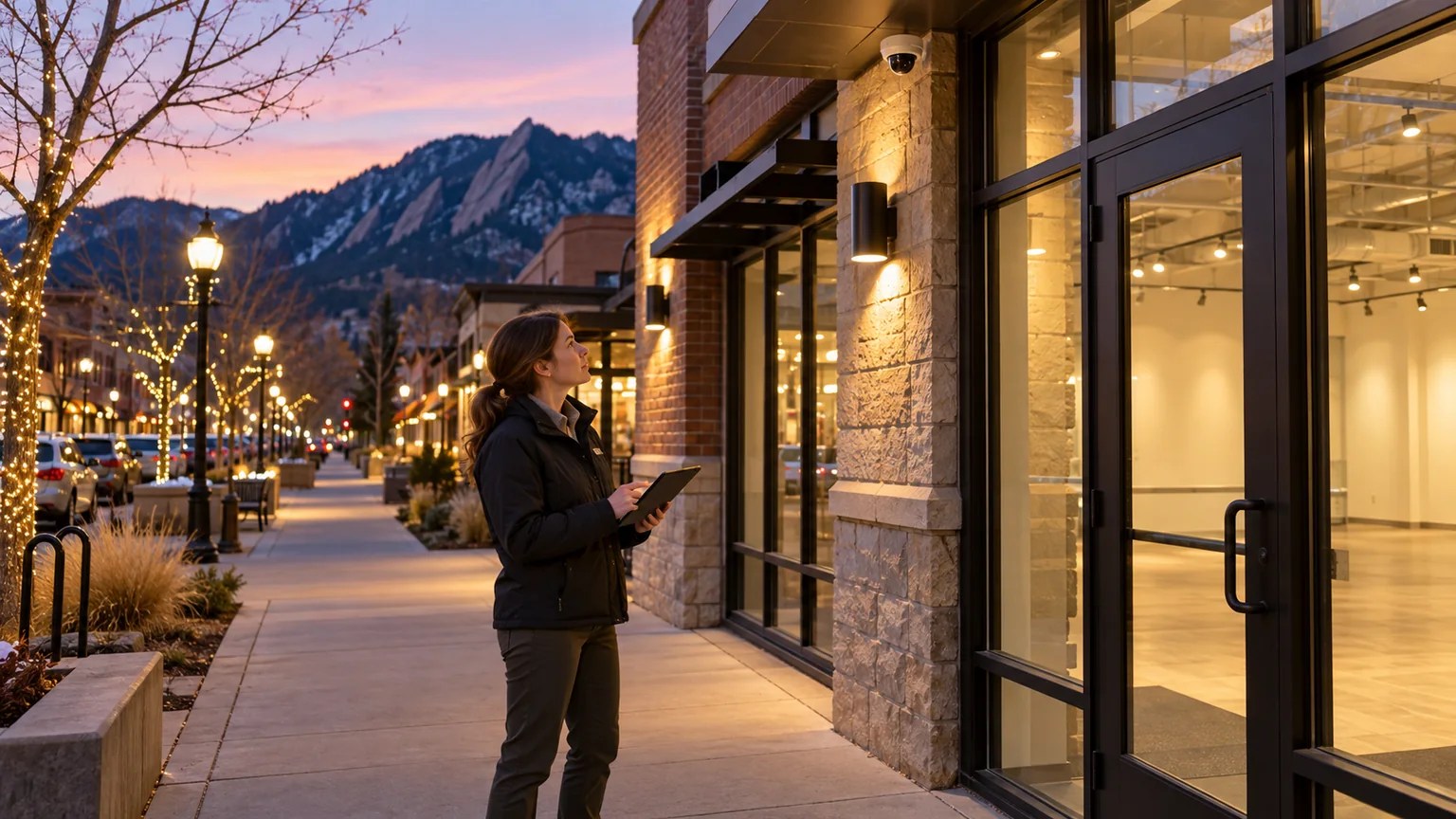
Boulder weather and seasonal issues to include
Colorado temperature swings can affect metal doors, frames, closers, lubricants, batteries, and weather seals. Snow and ice can obstruct an entrance or prevent a door from reaching the frame. Wind can stress closers or catch a door during service visits. Maintain safe access for authorized inspections and required emergency response.
Do not use household oil, force a stiff cylinder, alter panic hardware, or add an unapproved lock because the suite is empty. A vacancy does not suspend egress, fire, accessibility, lease, insurance, or building requirements. Coordinate significant hardware or access-control changes with the owner, property manager, qualified contractors, insurer, and local authorities as appropriate.
Prepare for the next tenant
Before possession changes again, give the incoming tenant a clean access baseline:
- a door and hardware condition report;
- a list of rekeyed and unchanged cylinders;
- the approved key hierarchy and quantity issued;
- active card, fob, or mobile credential inventory;
- administrator ownership and recovery process;
- alarm and emergency contact responsibility;
- open repair items and scheduled completion dates.
For multi-tenant sites, separate landlord-controlled common areas from tenant-controlled suite access. A new suite key should not unintentionally open another tenant area, and a tenant departure should not break property-management access. A qualified commercial locksmith can help survey the hierarchy before new keys are issued.
Six mistakes to avoid
- Assuming all keys were returned. Verify quantities and authority rather than relying on memory.
- Changing the cylinder but ignoring the door. Misalignment and failed latching remain security problems.
- Leaving former users active in the access platform. Physical badge collection does not revoke digital permission.
- Giving every broker or vendor the same code. Shared access is difficult to expire and attribute.
- Letting the space look abandoned. Maintain lighting, cleanliness, contact information, and routine presence.
- Failing to record inspections. A schedule without a completed log is hard to manage or verify.
The bottom line
Vacant commercial property security is a management process, not a single lock purchase. Establish authority, reconcile keys and credentials, inspect every opening, coordinate alarms and lighting, control temporary access, and document recurring checks. That gives the property a defensible baseline while it is marketed, maintained, or prepared for a new tenant.
Call Lock Pixies at (720) 304-5504 to schedule a commercial lock and access assessment for a Boulder property.
Frequently asked questions
Should I rekey a Boulder commercial property as soon as it becomes vacant?
Rekey promptly when keys are missing, copies cannot be accounted for, or former users still have access. If a controlled system has a reliable record and every issued key is returned, selective rekeying may be sufficient. Survey every opening before deciding.
How often should a vacant commercial space be inspected?
The appropriate frequency depends on the lease, insurer, property condition, weather, utilities, location, and risk profile. Use the strictest applicable requirement, document each inspection, and add checks after storms, showings, contractor visits, alarms, or service interruptions.
Should access control stay on in an empty building?
Usually the controlled system should remain properly powered and administered if it is part of the approved building operation. Remove former users, preserve required egress and emergency behavior, and confirm backup power and response procedures with qualified providers.
Who should have keys to a vacant Boulder storefront or office?
Only people with a documented operational need, such as the authorized owner or manager and specifically approved vendors or brokers. Use individual credentials, limited door groups, expiration dates, or signed key control rather than an unrestricted shared key.
Should the alarm code change after a tenant moves out?
Yes when the code was shared, known by former users, or cannot be tied to individuals. Remove former user accounts, update the monitoring call list, and test the system through the approved process. Do not rely on a code change alone if physical keys remain unaccounted for.
What should a commercial locksmith inspect at a vacant property?
The scope should include cylinders, key hierarchy, levers or trims, strikes, frames, hinges or pivots, closers, panic hardware, mechanical overrides, and the physical condition of openings connected to access control. The property team should separately confirm user permissions, alarm administration, utilities, and inspections.