

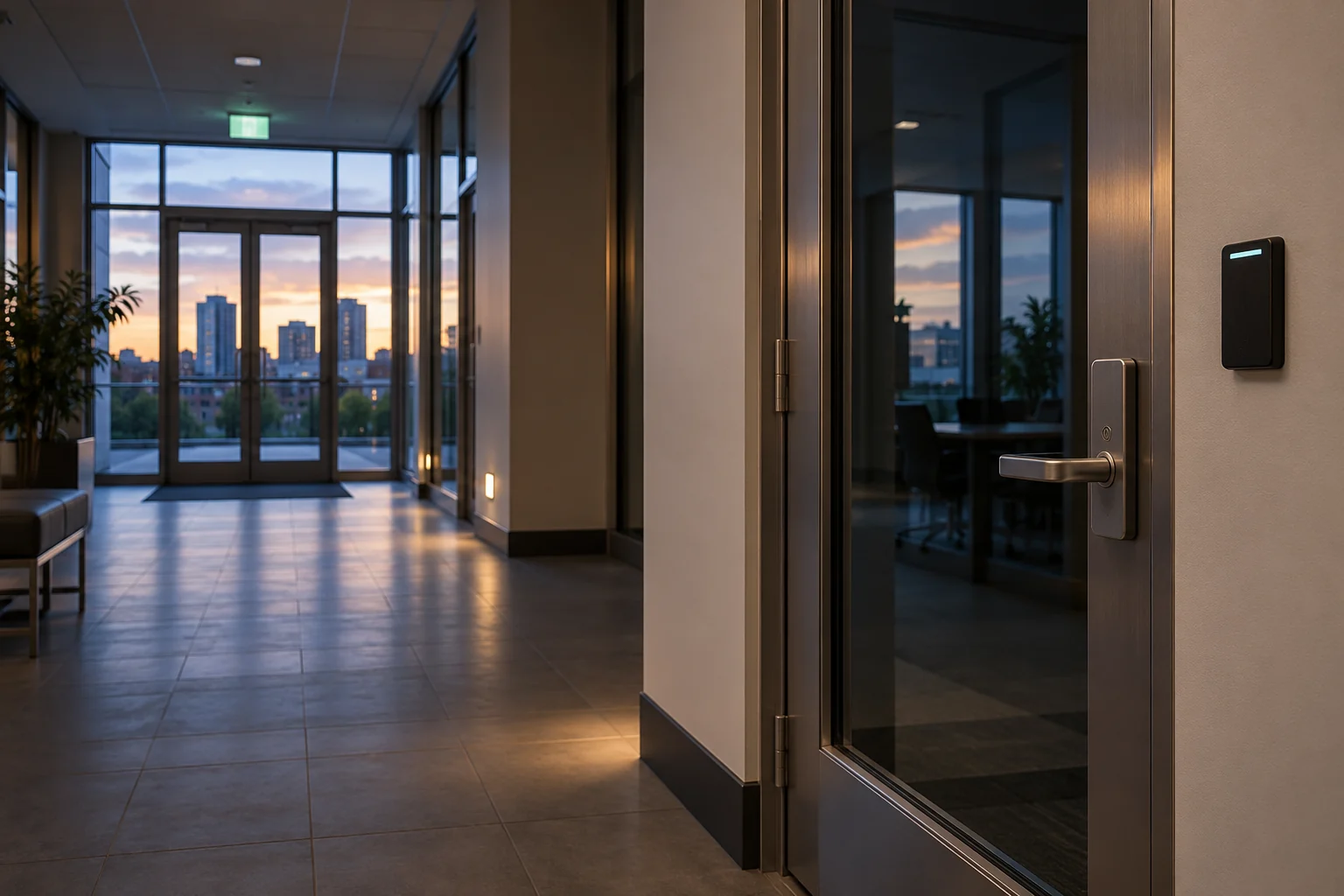
A commercial door may stay locked from outside, release, or continue operating on backup power when electricity fails. The result depends on the installed locking hardware, power supply, controls, and approved system design. Fail-safe and fail-secure describe power-loss behavior; neither label, by itself, tells you whether people can exit correctly.
The useful question for a Denver business is not simply whether the card reader has a light. Ask what happens at each opening when building power, the network, the controller, or a backup battery becomes unavailable. Those failures can produce different results, and a door that works during a short outage may behave differently when backup power is exhausted.
Before changing hardware, arrange a commercial door and lock assessment in Denver. The provider should identify the actual opening, confirm the installed products, and coordinate any electrical or fire-alarm work with the appropriate qualified parties.
Fail-safe and fail-secure: what the terms mean
For the access side of electrified locking hardware, fail-safe generally means the device unlocks when its power is removed. Fail-secure generally means it remains locked from that side without power. The inside lever or exit device and the complete approved arrangement determine how occupants leave.
| Term or condition | What it describes | What to verify separately |
|---|---|---|
| Fail-safe locking device | Releases its locking function when device power is removed | Required egress, alarm release, and approved application |
| Fail-secure locking device | Retains its locking function from the secured side without device power | Inside exit operation and authorized entry |
| Backup power | Continues supplying selected equipment for a limited period | Actual load, battery condition, and required emergency releases |
| Network outage | Communication is unavailable | Local credential decisions and remote-management limits |
A magnetic lock relies on electrical power for its magnetic holding force. An electric strike or electrified lockset may have a different specified function. Do not identify the function by appearance, a reader’s display, or the word “smart” on a product description. Confirm the manufacturer, model, configuration, and approved documentation.
One building can have several different answers
A street entrance, suite door, stairwell opening, and stockroom can serve different purposes. Their approved locking arrangements may therefore differ. A tenant’s experience at one reader does not establish how the shared lobby or every exit works. Ask the landlord which openings belong to the building system and which belong to the tenant.
Use a door schedule that records the opening ID, hardware model, power supply, access-side behavior, normal exit method, authorized backup-entry method, and service contact. Keep photographs of equipment labels and sensitive drawings in a restricted maintenance record.
Review the complete access control installation, including its controller and power supply. Battery capacity at a controller does not automatically provide power to every reader, lock, network device, and alarm component.
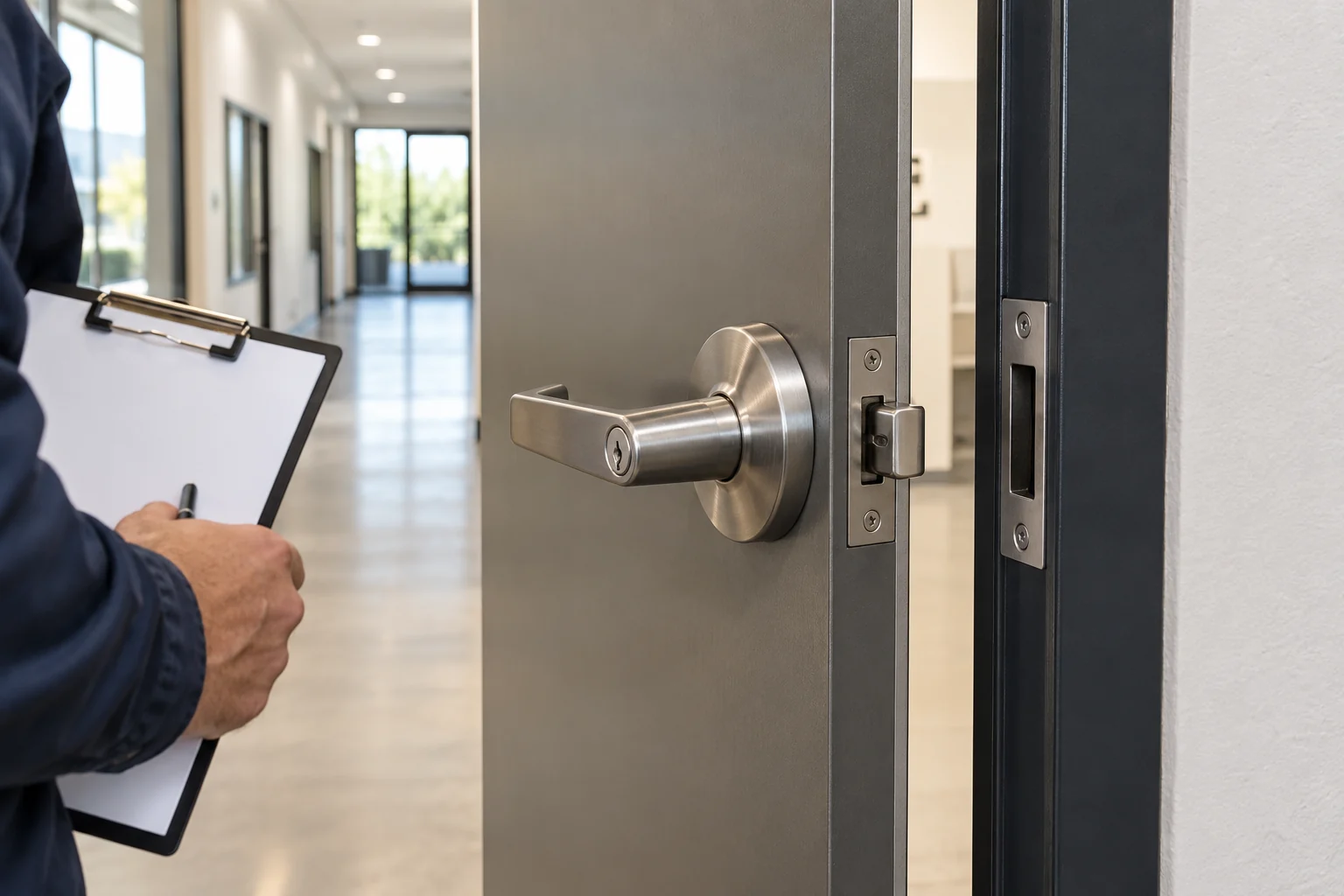
Power loss is different from internet loss
A cloud dashboard becoming unavailable does not necessarily mean the door stops accepting credentials. Some systems can make approved decisions locally. Conversely, a working internet connection cannot operate an unpowered device. Remote commands, visitor enrollment, event synchronization, and local entry may each have their own dependencies.
Ask the provider to document what continues to work in three conditions: network failure with power available, building-power failure while backup is available, and loss of the relevant backup supply. Include what happens when service returns, since a device may need time to reconnect or synchronize changes.
Do not assume a newly revoked credential reaches an offline controller immediately. Confirm the platform’s actual behavior and use the organization’s approved incident process if an urgent access change cannot be delivered.
Build an outage plan around people and doors
- Assign an on-site decision maker and a backup contact. Include property management and the providers responsible for access control, alarm systems, and electrical service.
- Identify the authorized way to enter each required space without relying solely on a phone app or live cloud connection.
- Keep the exit path clear. A lockout prevention plan must not depend on propping a fire door, defeating a latch, or adding an improvised locking device.
- Define how an unexpectedly unlocked exterior opening will be monitored while qualified help is arranged.
- Record faults and unusual behavior without publishing sensitive access details. Keep the incident record for the maintenance team.
- After restoration, verify normal door schedules, credentials, alarms, latching, and event reporting before treating the system as recovered.
A supported mechanical backup may be useful where it is part of the approved design. Confirm that the designated person actually has the correct key and authority to use it. Review the building’s master key arrangements rather than hiding a key near an entrance or distributing unrestricted copies.
Arrange a controlled test
Do not switch off circuits or disconnect batteries as an informal experiment in an occupied building. Testing may affect fire-alarm interfaces, emergency releases, shared systems, or other tenants. Have the responsible service providers agree on the scope, notifications, staffing, and recovery procedure.
A useful test report names each opening, the condition tested, expected and observed entry behavior, observed exit behavior, exceptions, and corrective work. It should distinguish an actual observed test from a prediction based on a product manual. For backup runtime, ask what load was measured and what assumptions apply rather than accepting an unsupported hour estimate.
A power issue can also expose an unrelated mechanical fault. If the door drags, fails to latch, or needs force to open, review the separate commercial door-latching guide and arrange inspection. Do not solve a mechanical problem by changing a reader schedule.
Denver approvals and safe exit operation
Hardware changes may affect the means of egress, a fire-rated assembly, electrical work, or fire-alarm coordination. The right arrangement depends on the specific door and its use. “Fail-safe” does not mean universally compliant, and “fail-secure” does not automatically mean unsafe.
Use Denver’s current Building and Fire Codes resources to confirm the applicable requirements and approval path with qualified contractors and the city. Do not add a separate deadbolt to an exit door as an outage workaround or alter emergency-release functions based on general internet advice.
What to tell Lock Pixies when requesting help
Describe whether the door is unexpectedly unlocked, will not admit an authorized person, or has a problem with exit operation. State whether people are inside, whether the building has power, which openings are affected, and whether a landlord or access provider manages the system. Share equipment details privately.
Call Lock Pixies at (720) 304-5504 for commercial lock inspection and service availability in the Denver metro. For an urgent access or security failure, request emergency locksmith service and explain the current condition. If anyone cannot exit safely or there is an immediate danger, contact emergency services.
Frequently asked questions
Does fail-secure mean people are locked inside?
No. The term generally describes the secured or access side of the electrified device when power is removed. The inside exit method must be evaluated separately as part of the complete approved opening. A properly designed arrangement can restrict outside entry while allowing the required exit operation.
Will a magnetic lock release during a blackout?
It loses its magnetic holding force when power to the magnet is removed. A building-power outage does not necessarily remove that power immediately if an approved backup supply is operating. Required emergency releases and fire-alarm behavior must still work as designed; backup power is not permission to defeat them.
Can a card reader work without internet?
It may, if the controller stores the necessary credentials and rules locally and has power. Features such as remote unlocking, new credential issuance, or immediate revocation may have different connectivity needs. Obtain an answer for your installed system and test it through an approved procedure.
How long will the backup battery keep the doors working?
There is no reliable universal duration. Runtime depends on equipment loads, battery size and condition, charging, temperature, and system design. Ask the responsible provider for the design requirement, maintenance record, and test results. A battery label by itself does not establish usable runtime for the entire installation.
Should every Denver business use fail-safe locks?
No single function suits every opening. Hardware selection must account for occupancy, egress, fire-door requirements, re-entry needs, security, product listings, and approved system operation. Have the opening assessed before purchase; choosing a reassuring product label is not a substitute for that review.
Can a locksmith fix every outage-related access problem?
The cause may be mechanical, electronic, electrical, network-related, or part of a fire-alarm interface. A commercial locksmith can assess the lock and door and help identify the service scope, but some work needs the access-control provider, qualified electrical or fire-alarm contractors, property manager, or city review.