

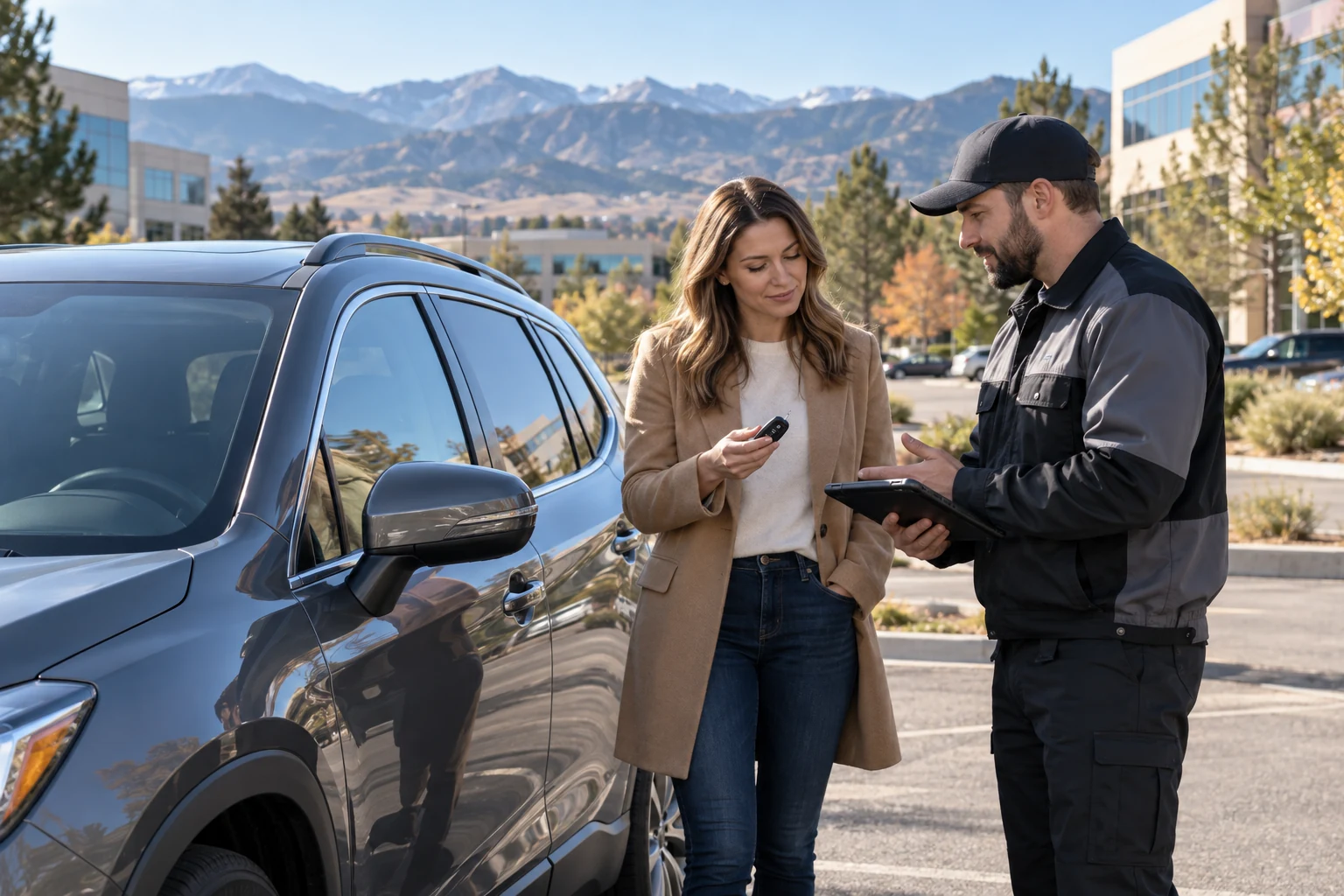
Short answer: Some keyless vehicles can be vulnerable to relay-style attacks, but a car that will not unlock is more often dealing with a weak fob battery, a damaged fob, a desynchronized or unprogrammed key, a failed vehicle battery, or a mechanical door-lock problem. Greenwood Village drivers should first separate a security concern from a service fault: confirm whether the spare fob works, test the mechanical emergency key without forcing it, check whether more than one door responds, and follow the vehicle manufacturer’s instructions.
The Greenwood Village Police Department describes vehicle theft and burglary as crimes that are often opportunistic. Its local crime and auto-security guidance advises drivers to close the windows, lock the vehicle, take the keys, remove visible valuables, and park in well-lit, busy areas. Those basics still matter even when the vehicle uses modern keyless entry.
This guide explains what a key-fob relay risk is, what it is not, how to recognize common car-door and key symptoms, and when an authorized locksmith service is the appropriate next call.
How does keyless entry normally work?
Remote keyless entry usually requires a button press to send a lock or unlock command. Passive entry systems can detect an authorized smart key near the vehicle and unlock when the handle is touched. Push-button start uses another authenticated exchange before the vehicle permits starting.
Those functions may be packaged in one fob, but they are not the same as the mechanical emergency key hidden inside many smart-key housings. That small key can provide authorized entry when the fob battery is depleted, provided the mechanical cylinder is maintained and the correct access point is used.
Lock Pixies provides locksmith service in Greenwood Village for drivers dealing with lost keys, damaged fobs, lockouts, and vehicle-door lock problems.
What is a key-fob relay attack?
A relay attack attempts to extend the communication between a passive-entry vehicle and its legitimate key. The vehicle may behave as though the real key is nearby even though it remains inside a home or office. This is different from physically stealing the key, copying a metal blade, breaking the door handle, or exploiting another vehicle system.
Not every keyless vehicle works the same way, and not every unexplained unlock is proof of a relay attack. Vehicle manufacturers use different radio technologies, sleep modes, motion sensors, ultra-wideband features, and software strategies. Check the owner’s manual or manufacturer guidance for your exact year, make, model, and fob.
Seven practical key-fob security steps
- Lock the vehicle and verify it. Watch for the normal visual or audible confirmation and check the handle if appropriate.
- Keep keys away from exterior doors and windows. Do not leave the fob in the vehicle, garage, or an obvious entryway location.
- Use the manufacturer’s sleep or disable function when available. Procedures vary, so follow the owner’s manual rather than an online shortcut for another model.
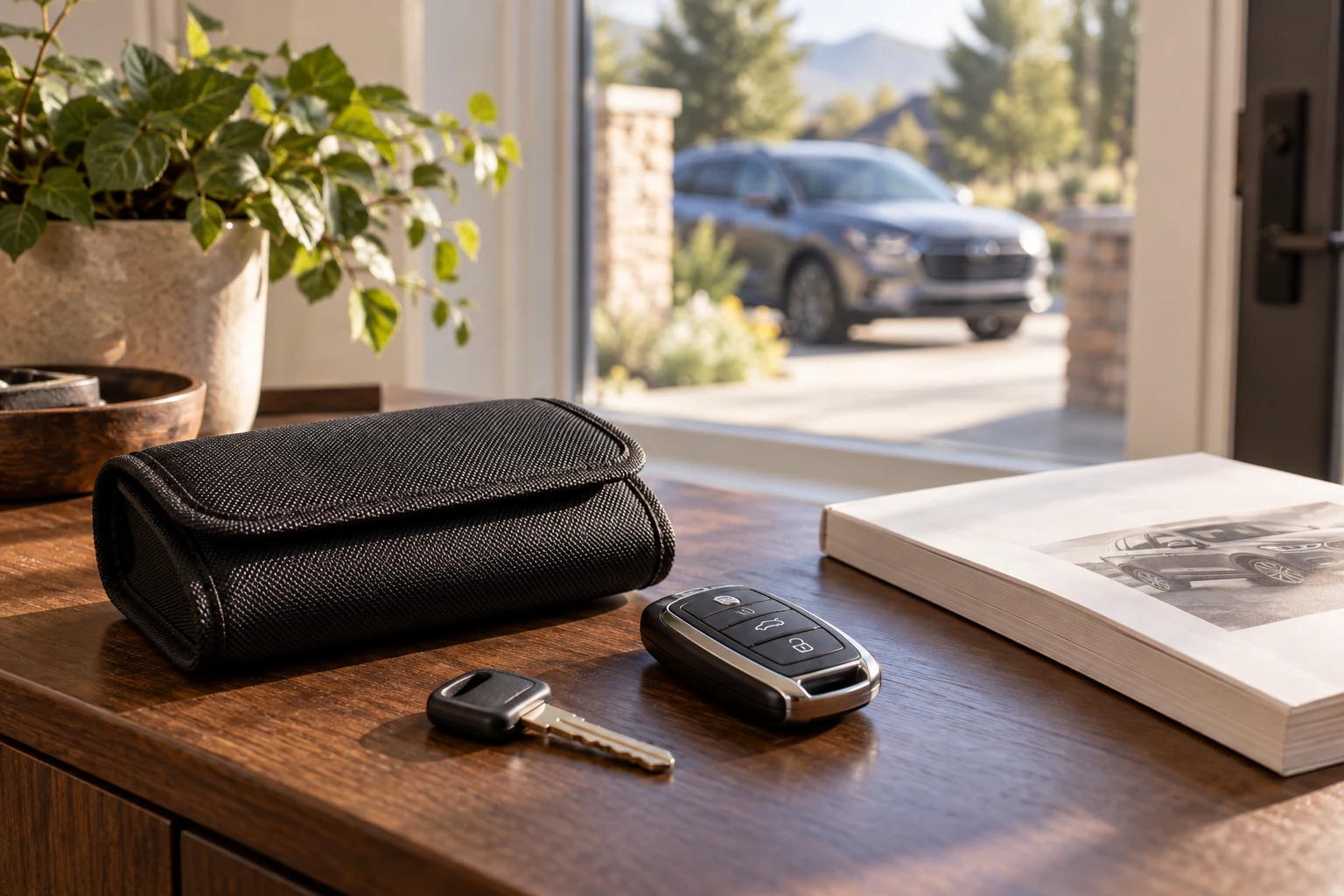
- Consider a quality signal-blocking pouch or box for passive-entry keys. Test it by placing the key inside, closing it fully, and confirming the vehicle does not detect the fob. Replace it if the lining or closure is damaged.
- Protect the diagnostic port and follow model-specific theft guidance. A pouch addresses only radio relay risk; it is not a universal anti-theft solution.
- Remove valuables and garage access devices. A locked vehicle can still attract a break-in when desirable items are visible.
- Use layered protection. Lighting, secure parking, alarms, tracking options, and visible physical deterrents address different risks.
Is it a security risk or an ordinary key-fob problem?
The fob battery may be weak when:
- Buttons work only at a very short distance.
- Response is intermittent but the spare fob works normally.
- The vehicle displays a low-key-battery warning.
- Passive entry fails but the close-range start procedure still works.
The fob may need repair, replacement, or programming when:
- The housing is cracked, wet, crushed, or missing buttons.
- A battery change does not restore operation.
- The vehicle recognizes one authorized fob but not the other.
- A replacement key has been cut but has never been paired correctly.
For vehicle-specific diagnosis, Lock Pixies offers key-fob programming services. Programming requires proof of ownership and compatible equipment; it is not the same as copying a household key.
The vehicle battery may be involved when: interior lights, locks, displays, and other electrical functions are also dead or unusually weak. A locksmith can address keys and locks, but a battery, charging-system, or broader electrical fault may require roadside or automotive repair service.
When is the car-door lock itself the problem?
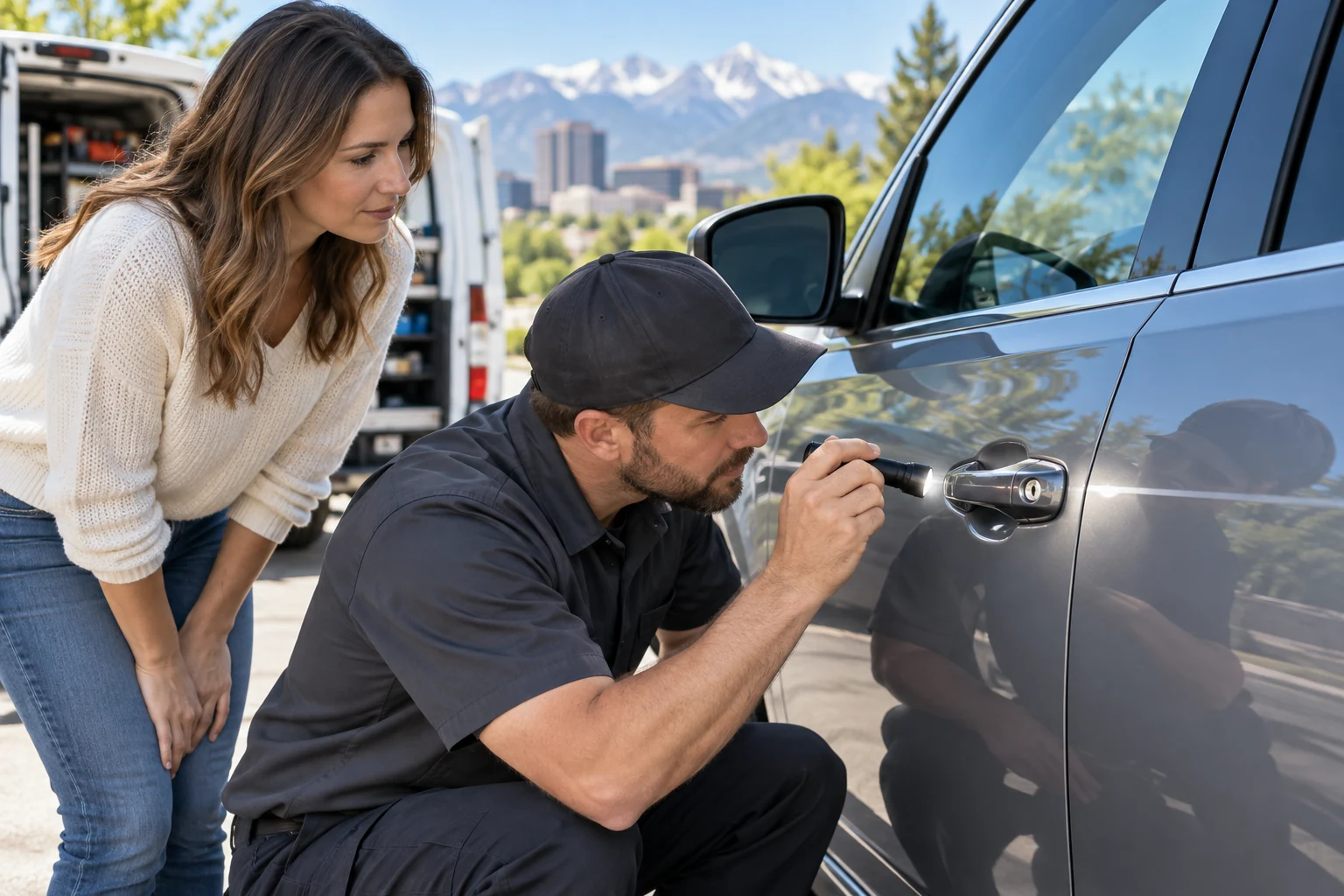
A door-lock problem is more likely when one door behaves differently from the others, the handle feels loose, the key cylinder will not turn with the correct key, the lock actuator clicks without moving, the door reports open when it is closed, or visible impact damage surrounds the handle or cylinder.
Do not force a stiff mechanical key. Many emergency cylinders are rarely used and can accumulate contamination or corrosion. Excessive force may bend the blade or damage the cylinder, creating a more difficult lockout. Arrange an authorized car-door lock inspection and repair if the correct key will not operate normally.
What should you do after a car key or fob is lost or stolen?
- Confirm the vehicle’s location and secure it if you can do so safely.
- Check whether a spare authorized key is available.
- Write down the year, make, model, and VIN, and prepare proof of ownership and identification.
- Tell the service provider whether the key is lost, stolen, damaged, locked inside, or simply not responding.
- Ask whether the missing credential can be removed from the vehicle’s authorized-key memory.
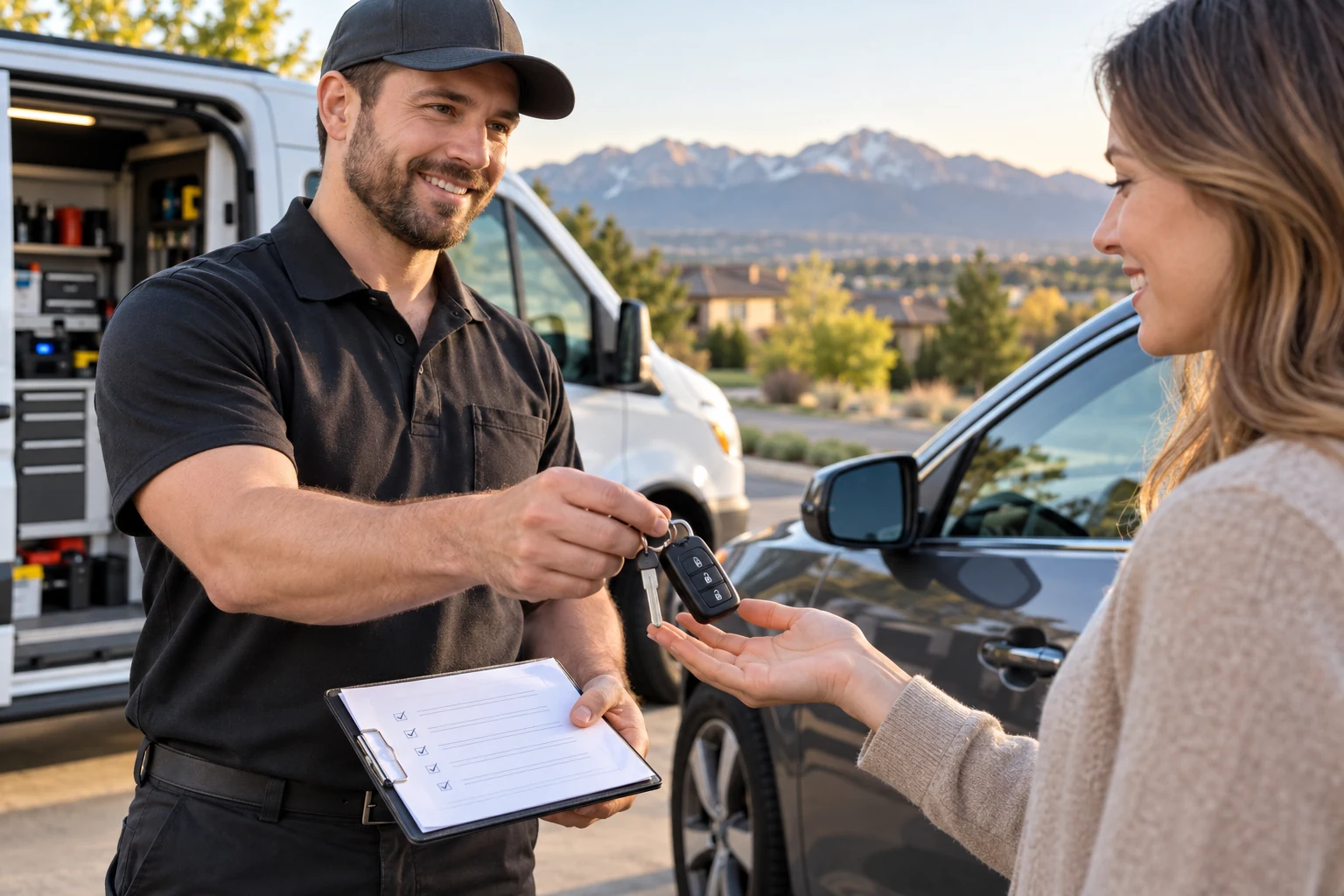
- Test every new and remaining key for lock, unlock, emergency entry, and start functions before closing the job.
Lock Pixies’ car key service covers many replacement and duplication needs across the Denver metro. Availability and procedure depend on the vehicle.
Replacement, programming, battery service, or door repair?
Battery service is appropriate when the fob is otherwise intact and its signal has become weak. The correct battery orientation and a clean, undamaged contact are important.
Fob replacement is appropriate when the housing, circuit board, transponder, or buttons are damaged or the key is missing. See key-fob replacement options for compatible vehicle service.
Programming authorizes a compatible transponder or smart key to the vehicle. A cut blade without the correct electronic authorization may unlock a door yet fail to start the engine.
Mechanical door repair addresses the cylinder, handle, linkage, latch, or related door components. Reprogramming cannot repair a broken handle or seized cylinder.
What can an automotive locksmith verify?
An authorized automotive locksmith can often confirm key compatibility, test fob functions, cut an emergency blade, program supported replacement keys, remove some missing keys from authorized memory, open a locked vehicle without unnecessary damage, and diagnose mechanical lock symptoms.
A locksmith cannot honestly determine from one symptom that a relay attack occurred, guarantee that a pouch defeats every vehicle-theft method, repair every electrical module, or replace law-enforcement reporting after a theft. Clear boundaries are part of trustworthy service.
Information to gather before calling
- Vehicle year, make, model, and trim if known.
- Whether the ignition uses a blade, transponder key, proximity fob, or push button.
- Exactly what happens when you press the buttons, touch the handle, use the mechanical key, or attempt to start.
- Whether a spare key works.
- Whether the vehicle battery and interior electrical systems appear normal.
- Any recent water damage, impact, battery replacement, repair, or attempted break-in.
- Proof of ownership and photo identification.
The bottom line
Key-fob security works best as layers: lock and verify the vehicle, keep keys controlled, follow the manufacturer’s model-specific guidance, reduce visible opportunity, and use a tested signal-blocking container when it is appropriate for a passive-entry system. If the vehicle will not unlock or start, diagnose the ordinary causes before assuming an attack.
Call Lock Pixies at (720) 304-5504 for authorized car-key, key-fob, lockout, and car-door lock service in Greenwood Village and the Denver metro.
Frequently asked questions about key-fob and car-door security
Does a Faraday pouch stop every type of car theft?
No. A working signal-blocking pouch can reduce exposure to attacks that depend on communicating with the key while it is inside the pouch. It does not address a stolen key, broken window, tow-away theft, diagnostic-port attack, compromised account, or every vehicle-specific technique. Test the pouch and combine it with other precautions.
How do I unlock my car if the key-fob battery is dead?
Many fobs contain a mechanical emergency key and many vehicles provide a concealed door cylinder or manufacturer-defined backup procedure. Check the owner’s manual for the correct method. Do not pry trim or force a key into an unfamiliar opening.
Can a locksmith replace one lost fob if I still have another?
Often, yes, if the vehicle and key type are supported and the owner provides the required documentation. Having a working key may simplify some procedures. Ask whether the missing fob can also be removed from the vehicle’s authorized-key memory.
Why does only one car door fail to unlock?
If the other doors respond normally, the affected door may have an actuator, latch, linkage, wiring, handle, or mechanical-cylinder problem. The fob is less likely to be the sole cause because it sends a vehicle-level command.
My car was unlocked with no visible damage. Was the fob hacked?
It is one possibility, but the symptom does not prove the method. The vehicle may have been left unlocked, a door may not have latched, another key may exist, an app or account may be involved, or a different entry technique may have been used. Preserve available video or records and report theft or suspicious activity to police.
Can any used key fob be programmed to my vehicle?
No. Compatibility depends on the part number, frequency, transponder or smart-key generation, vehicle configuration, and whether the fob can be reused. Buying an unverified used fob can cost more if it cannot be programmed. Confirm compatibility before purchase.